Description
Target Audience: Homeschool moms + Daycare providers
Primary Keyword: “fine motor skills preschool” (3,600 searches/mês)
Secondary Keywords: “fine motor activities”, “preschool cutting practice”, “strengthen hand muscles preschoolers”
Meta Description (159 caracteres): “Easy fine motor activities for preschoolers using household items. No-prep ideas to strengthen little hands for writing. Free cutting practice sheets!”
You hand your preschooler a crayon and notice they’re gripping it with their whole fist. You give them child-safe scissors and they struggle to make even one snip. You watch them try to button their coat and it takes five frustrating minutes.
Welcome to the world of fine motor development—one of the most important (and often overlooked) areas of preschool learning.
Here’s the truth: strong fine motor skills are essential for kindergarten readiness. Your child needs hand strength, finger dexterity, and hand-eye coordination to write letters, cut paper, tie shoes, button clothes, and handle all the self-care tasks that make them independent.
The good news? You don’t need expensive therapy tools or elaborate activities. The best fine motor practice uses simple household items and takes almost no prep time.
Whether you’re a busy homeschool mom juggling multiple kids, a daycare provider with limited planning time, or a preschool teacher looking for quick activities, this guide gives you everything you need.
What you’ll learn:
- Why fine motor skills matter for kindergarten readiness
- The developmental progression (what’s normal at each age)
- 40+ no-prep activities using things you already own
- How to improve pencil grip naturally
- When to worry and when to relax
- Free printable cutting practice sheets
Let’s build those little hand muscles!
What Are Fine Motor Skills? (And Why They Matter)
Fine motor skills are the small muscle movements in your child’s hands, fingers, and wrists. These are the skills that let them:
- Hold a pencil and write
- Use scissors to cut
- Button, snap, and zip clothing
- Tie shoelaces
- Use utensils to feed themselves
- Turn pages in a book
- Manipulate small objects (puzzle pieces, legos, beads)
Why this matters for school readiness:
Kindergarten teachers consistently rank fine motor skills as one of the most important readiness factors—even more important than knowing all their letters! A child with strong hands can focus on learning. A child who struggles with basic tasks (holding a pencil, cutting on a line) gets frustrated and falls behind.
The problem: Many kids today have weaker fine motor skills than previous generations. Why? Less time playing with hands-on materials (playdough, blocks, arts and crafts) and more time on screens (which use only finger tapping, not hand strengthening).
The solution: Daily opportunities to use their hands in different ways. It doesn’t need to be fancy or time-consuming—just consistent.
Fine Motor Development: What’s Normal at Ages 3-4?
Understanding what to expect at each age helps you provide appropriate activities—not too easy (boring) and not too hard (frustrating).
Typical 3-Year-Old Fine Motor Skills
By age 3, most children can:
- String large beads onto a lace
- Turn pages in a book one at a time
- Build a tower of 9-10 blocks
- Snip paper with scissors (not cutting on lines yet)
- Hold a crayon with whole hand or emerging tripod grasp
- Copy a circle (roughly)
- Use a spoon and fork with some spilling
- Turn doorknobs and unscrews lids
What’s still developing:
- Precise pencil control
- Cutting along lines
- Using both hands together in coordinated ways
Buttoning and snapping
The Secret to Strong Fine Motor Skills (Make It Daily & Fun)
You don’t need special therapy tools. What you need is daily opportunities for hands-on manipulation—and the best activities feel like play, not work.
The three types of fine motor practice:
- Strengthening Activities – Build the muscles in hands, fingers, and wrists. Think: squeezing, pinching, pulling, pushing.
- Dexterity Activities – Develop finger control and coordination. Think: picking up small objects, manipulating tools, precision movements.
- Bilateral Coordination – Using both hands together in coordinated ways. Think: tearing paper while one hand holds, stringing beads, cutting with scissors.
The best activities naturally combine all three. And the very best? They’re things your child WANTS to do.
Early Math Concepts (More Than Just Counting)
Preschool math is about building number sense—an intuitive feel for how numbers and quantities work.
What this looks like:
- Counting objects to 10 (and beyond for some)
- Recognizing numerals 1-5
- Understanding one-to-one correspondence (touching one object for each count)
- Comparing sizes: big/small, long/short, tall/short
- Sorting objects by one attribute (all the red ones, all the circles)
- Creating and extending simple patterns (red-blue-red-blue)
- Recognizing basic shapes: circle, square, triangle, rectangle
Real-life preschool activities: Count everything throughout your day: “Let’s count the stairs as we go up! One, two, three…” Sort toys by color or size during cleanup. Bake together and let them pour, measure, and count. Build with blocks and talk about shapes. Play with pattern blocks or colored bears. Set the table and count plates and forks together.
Math is everywhere: When you give them crackers for snack, count them. When you’re getting dressed, talk about which sock is longer. When you’re outside, find shapes in nature. The best preschool math curriculum is just intentional conversation about quantities, sizes, and patterns.
🔢 Get 50+ activities: Preschool Math for Ages 3-4: Hands-On Counting & Number Games
Science & Exploration (Nurturing Natural Curiosity)
Your 3-4 year old is a born scientist—everything is new and fascinating! Your role is to encourage observation, questioning, and hands-on exploration.
What this looks like:
- Observing nature and living things
- Asking questions about how things work
- Making simple predictions: “What will happen if…?”
- Exploring the five senses
- Learning about weather and seasons
- Understanding basic animal needs (food, water, shelter)
- Simple cause-and-effect relationships
Real-life preschool activities: Go on “nature detective” walks with a magnifying glass. Create a sensory bin with rice, beans, or water. Plant seeds in a clear cup and watch roots grow. Feed birds and observe them. Talk about the weather every morning. Freeze toys in ice and “rescue” them. Mix baking soda and vinegar. Observe shadows at different times of day.
The secret to preschool science: Follow your child’s interests! If they’re fascinated by bugs, spend a week learning about insects. If they love the moon, do moon activities. Curiosity-driven learning sticks.
🔬 Try these: 25 Simple Science Experiments for 3-4 Year Olds
40+ No-Prep Fine Motor Activities (Using What You Already Have)
These activities require minimal to zero prep and use household items. They’re organized by material so you can quickly find something based on what’s available
Get Free Learning Activities!
Join thousands of parents and teachers who receive our best activities, tips, and printables every week. Plus, get instant access to our exclusive resource library!
No spam, ever. Unsubscribe anytime.
Playdough Activities (The #1 Fine Motor Builder)
Playdough is the single best fine motor tool. The resistance as they squeeze, roll, pinch, and poke builds hand strength like nothing else.
- Free Play Playdough Time Just let them play! Squishing, rolling, and manipulating playdough builds strength. No activity needed—this IS the activity.
- Playdough Snakes Roll playdough into “snakes” (long cylinders). This rolling motion strengthens hands and wrists. Make them thick, thin, long, short.
- Hide & Seek in Playdough Hide small objects (coins, buttons, small toys) in playdough. Have your child dig them out with fingers. This builds finger strength.
- Playdough Prints Press objects into playdough to make prints: forks, legos, toy cars, coins. Remove and see the impressions.
- Cutting Playdough Give them child-safe scissors to cut playdough snakes. This is easier than cutting paper and builds the scissor motion without frustration.
- Playdough Pizza or Pancakes Flatten playdough with hands or a rolling pin, then “cut” slices with a plastic knife. Pretend to eat!
Note: You can make homemade playdough (flour, salt, water, oil, food coloring) or buy it. Either works. Keep it accessible so your child can use it daily.
Cutting Practice (Building Scissor Skills)
Cutting is a complex skill that requires hand strength, bilateral coordination, and visual-motor control. Start easy and progress slowly.
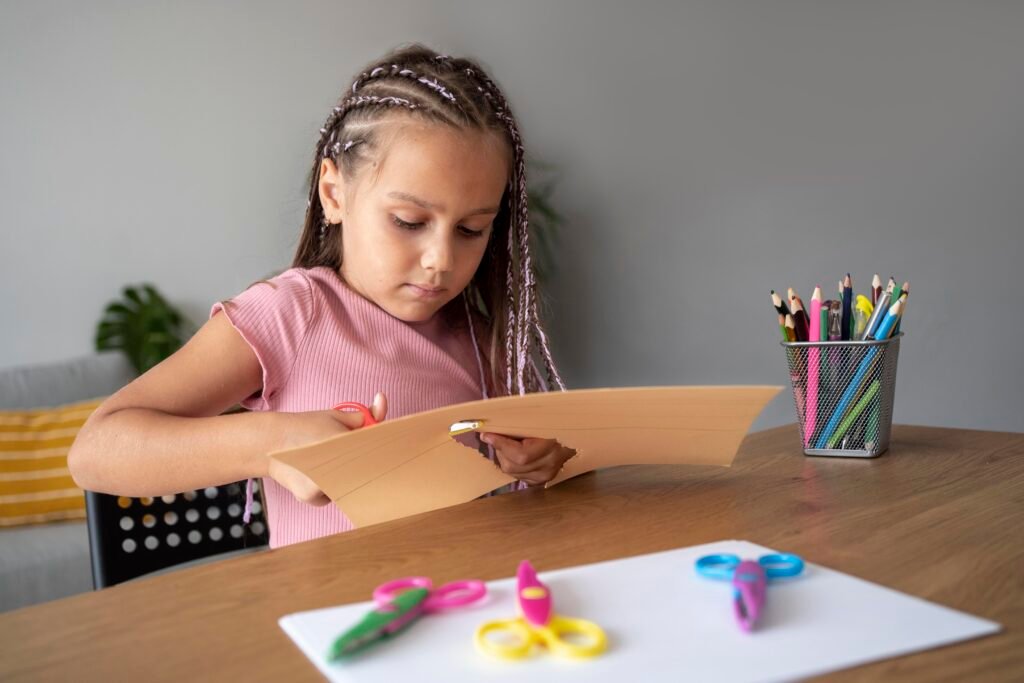
- Snipping Straws Give your child thick straws and scissors. Just snip! Each cut makes a satisfying piece fall. This teaches the basic scissor motion.
- Cutting Playdough Snakes (See above—easier than paper and builds confidence!)
- Fringe Cutting Give your child a strip of paper. Show them how to make cuts from the edge toward the center (but not all the way across). This makes “fringe” and is easier than cutting lines.
- Cutting Straight Lines Draw thick straight lines on paper (or use our free printables). Have your child cut along the line. Start with wide lines, progress to thinner.
- Cutting Shapes Once straight lines are mastered, try cutting simple shapes: circles, squares. Curves are harder than straight lines.
- Junk Mail Cutting Give them junk mail and let them cut freely. No pressure for accuracy—just practice the motion.
Scissor tips:
- Use child-safe scissors with blunt ends
- Make sure they’re right-handed or left-handed scissors (yes, it matters!)
- Model proper hand position: thumb on top
- It’s okay if they hold paper upside down or turn it oddly—that’s fine motor problem-solving!
Tearing & Ripping Activities
Tearing paper is actually HARDER than cutting and builds incredible hand strength.
- Paper Tearing Give your child old magazines, junk mail, or scrap paper. Let them tear freely. The bilateral coordination (one hand holds, one hand tears) is excellent practice.
- Torn Paper Collages Tear colored paper into pieces. Glue onto another paper to create a collage. This combines tearing with gluing (more fine motor!).
- Confetti Making Tear paper into tiny pieces to make “confetti.” Kids love this (and the mess is worth it for the skill-building!).
Pinching & Picking Up Activities
These build the pincer grasp (thumb and pointer finger)—essential for pencil grip.
- Tweezers or Tongs Transfer Provide tweezers or kitchen tongs and small objects (pom poms, cotton balls, beans). Transfer from one bowl to another. This builds precision and strength.
- Clothespin Games Clip clothespins around the edge of a container or cardboard. The pinching motion strengthens the same muscles used for pencil grip.
- Sticker Peeling Give your child a sheet of stickers. Peeling stickers off requires pincer grasp and patience. Let them stick freely on paper.
- Feeding with Pincer Grasp During snack time, offer small foods that require pincer grasp: raisins, cheerios, blueberries. Let them feed themselves.
- Picking Up Small Objects Give them small objects to pick up and place into a container: dry beans, buttons, pennies, small pom poms. (Supervise for safety with young 3s!)
Threading & Lacing Activities
- Stringing Large Beads Use large wooden beads and thick string or a shoelace. String beads. This builds hand-eye coordination and bilateral skills.
- Pasta Necklaces Thread pasta (penne, rigatoni) onto yarn. Tie ends to make a necklace. Kids love wearing their creation!
- Cheerio Necklaces Same concept but with cheerios—and they can eat their creation after!
- Lacing Cards You can buy these or DIY: punch holes around the edge of cardboard and “sew” with yarn.
Building & Construction Activities
- Building with Blocks Stacking, balancing, and fitting blocks together builds hand strength and spatial skills. Duplos, wooden blocks, or cardboard blocks all work.
- Lego Building Pushing legos together and pulling them apart requires significant hand strength. Perfect fine motor practice.
- Puzzles Picking up puzzle pieces with pincer grasp and fitting them into place builds dexterity. Start with 4-8 piece puzzles at age 3, progress to 12-24 pieces at age 4.
Art & Craft Activities (Low-Prep)
- Coloring & Drawing Daily drawing and coloring builds pencil control. Provide various tools: crayons, markers, colored pencils. Each has different resistance levels.
- Painting with Cotton Swabs Dip cotton swabs in paint and “dot” to create pictures. This pincer grasp practice is easier than holding a brush.
- Gluing Using glue bottles (squeeze) or glue sticks (apply pressure and control) both build hand strength. Let them glue torn paper, shapes, or found objects.
- Stamping Use stamps with ink pads. The pressing motion builds hand and wrist strength.
- Tearing and Gluing Collages Tear colored paper, then glue pieces onto another paper. This combines multiple fine motor skills.
Practical Life Activities (The Montessori Secret)
These are real-life tasks that build independence AND fine motor skills. No prep needed—just include your child in daily activities.
- Pouring Practice Let your child pour their own drinks (start with water in small pitchers). Pouring builds hand-eye coordination and wrist control.
- Spreading with a Knife Spread butter, peanut butter, or cream cheese on toast or crackers using a butter knife. Excellent bilateral coordination practice.
- Stirring & Mixing Let them stir pancake batter, mix muffin ingredients, or stir their own hot chocolate. Stirring builds wrist and arm strength.
- Opening Containers Practice opening and closing various containers: tupperware lids, water bottles, jars. The twisting and pulling motions are great practice.
- Buttoning Practice Get a large-buttoned shirt or jacket. Practice buttoning and unbuttoning. Start with large buttons, progress to smaller.
- Zipping & Snapping Practice zippers on jackets. Practice snaps on clothes. These self-help skills are also fine motor practice!
- Helping with Laundry Let them match socks (bilateral coordination), fold washcloths, or hang clothes with clothespins.
- Setting the Table Carrying plates, placing utensils, folding napkins—all fine motor practice disguised as helpfulness!
Sensory Bin Fine Motor Play
- Scooping & Transferring Fill a bin with rice, beans, or water beads. Provide scoops, spoons, or cups. Let them transfer from one container to another.
- Buried Treasure Hunt Hide small toys in rice or beans. Have your child dig to find them using their fingers (not scooping). This builds hand strength.
Improving Pencil Grip (Without Nagging)
Many parents worry about pencil grip. Here’s the truth: pencil grip naturally improves with age and practice—but you can help it along.
The progression of pencil grip:
Age 2-3: Fisted Grasp – Holds crayon in whole fist. Totally normal! Their hands aren’t strong enough yet for more refined grips.
Age 3-4: Digital Pronate Grasp – Holds crayon with fingers but arm moves to draw (not just fingers and wrist). Still developing!
Age 4-5: Tripod Grasp Emerging – Begins holding pencil with thumb, pointer, and middle finger. This is the “mature” grasp we want eventually.
Age 5-6: Dynamic Tripod Grasp – Mature pencil grip with movement coming from fingers, not whole arm.
How to encourage proper grip without frustrating your child:
- Strengthen hands first – You can’t have good pencil grip without hand strength. Focus on playdough, squeezing, and pinching activities.
- Use short crayons or pencils – Break crayons in half. Short writing tools naturally encourage tripod grasp because they can’t hold them with their whole fist.
- Try triangle-shaped crayons – The three sides naturally position fingers in tripod grasp.
- Vertical surface writing – Tape paper to a wall or easel and have your child draw standing up. Vertical surfaces encourage proper wrist position.
- Don’t nag – Constant correction creates resistance. Instead, model proper grip and provide tools that encourage it naturally.
When to seek help: If your child is age 5+ and still using a fisted grasp with no progression toward tripod grasp, talk to your pediatrician about an occupational therapy evaluation.
Common Fine Motor Mistakes to Avoid
Mistake #1: Too Much Screen Time, Not Enough Hand Use Screens require only finger tapping—not the varied hand movements that build strength. Limit screens and prioritize hands-on play.
Mistake #2: Pushing Pencil Work Too Early Worksheets and tracing pages before hands are ready creates frustration and poor habits. Build strength first through play, formal writing later.
Mistake #3: Doing Everything FOR Your Child It’s faster to button their coat yourself, but they need the practice! Let them struggle (with patience and encouragement). Independence = skill building.
Mistake #4: Not Providing Daily Opportunities Fine motor skills improve with consistent practice. One playdough session per week isn’t enough—aim for daily hands-on activities.
Mistake #5: Comparing to Other Kids Some 3-year-olds have advanced fine motor skills; others are still developing. Each child’s timeline is unique. Focus on YOUR child’s progress, not comparisons.
When to Worry About Fine Motor Delays
Most children develop fine motor skills naturally with exposure and practice. However, some children need extra support.
Talk to your pediatrician if your child:
- Shows no interest in using their hands by age 3.5
- Can’t grasp or hold objects at age 4
- Has significant difficulty with simple tasks (can’t stack blocks, can’t hold a crayon)
- Shows extreme frustration with hands-on activities
- Avoids fine motor tasks entirely
- Has hand dominance that hasn’t emerged by age 4-5
Early intervention makes a huge difference. Occupational therapy can help children catch up quickly, and it’s usually covered by insurance or early intervention programs.
Frequently Asked Questions About Fine Motor Skills
How long does it take to build fine motor skills? Fine motor development is gradual and continues through early elementary years. With daily practice, you’ll see improvements within weeks—but mastery takes months and years. Be patient and consistent.
My child hates coloring and drawing. What should I do? Not all kids love coloring! Focus on activities they DO enjoy: playdough, building blocks, helping in the kitchen. There are many paths to building fine motor skills.
Should I buy special therapy tools? You don’t need to! Household items work just as well as expensive tools. If you want a few extras, tweezers, clothespins, and playdough are your best investments.
Can too much screen time affect fine motor development? Yes. Screens use only finger tapping, not the varied hand movements needed for strength and dexterity. Limit screens and prioritize hands-on play.
My 4-year-old still grips their pencil in a fist. Should I be worried? Many 4-year-olds are still transitioning to tripod grasp. Focus on strengthening activities and using short crayons. If there’s no improvement by age 5, consult your pediatrician.
Is it normal for my child to switch hands? Most children establish hand dominance between ages 3-5. Some switching is normal during this time. If they’re still switching constantly after age 5, mention it to your pediatrician.
Conclusion: Strong Hands = Confident Learners
Every time your preschooler squeezes playdough, tears paper, or practices cutting, they’re building the foundation for writing, self-care, and independence.
You don’t need elaborate activities or expensive tools—you just need daily opportunities for hands-on play.
Remember:
- Playdough daily (seriously—it’s that important!)
- Let them help with real-life tasks
- Provide cutting practice regularly
- Use short crayons and varied art materials
- Be patient—skills develop over time
- Celebrate small victories
Continue your preschool journey:
- Toddler Alphabet Workbook – Animal Sounds Habitats Dot Marker Tracing Fine Motor Ages 2-4
- Pre-K Kindergarten Animal Alphabet Workbook – Habitats Tracing Handwriting Dot Marker
- My Busy Book – Cut Match Activities for Preschool and Kindergarten
- Preschool Skills Assessment – Pre-K Portfolio Kindergarten Readiness
- Ultimate Homeschool Planner – Complete Learning Kit
Want a complete curriculum with fine motor activities built in? Our Complete Preschool Curriculum includes weekly fine motor activities, printables, and no-prep ideas for the entire year!
Looking for monthly and seasonal preschool unit themes? We also offer monthly preschool and Pre-K curriculum units with ready-to-use lesson plans, printables, and activities for themes like Back to School, Thanksgiving, Christmas, Fall, Winter, Spring, Easter, and more.
👉 Explore our Monthly Preschool Curriculum Units ★